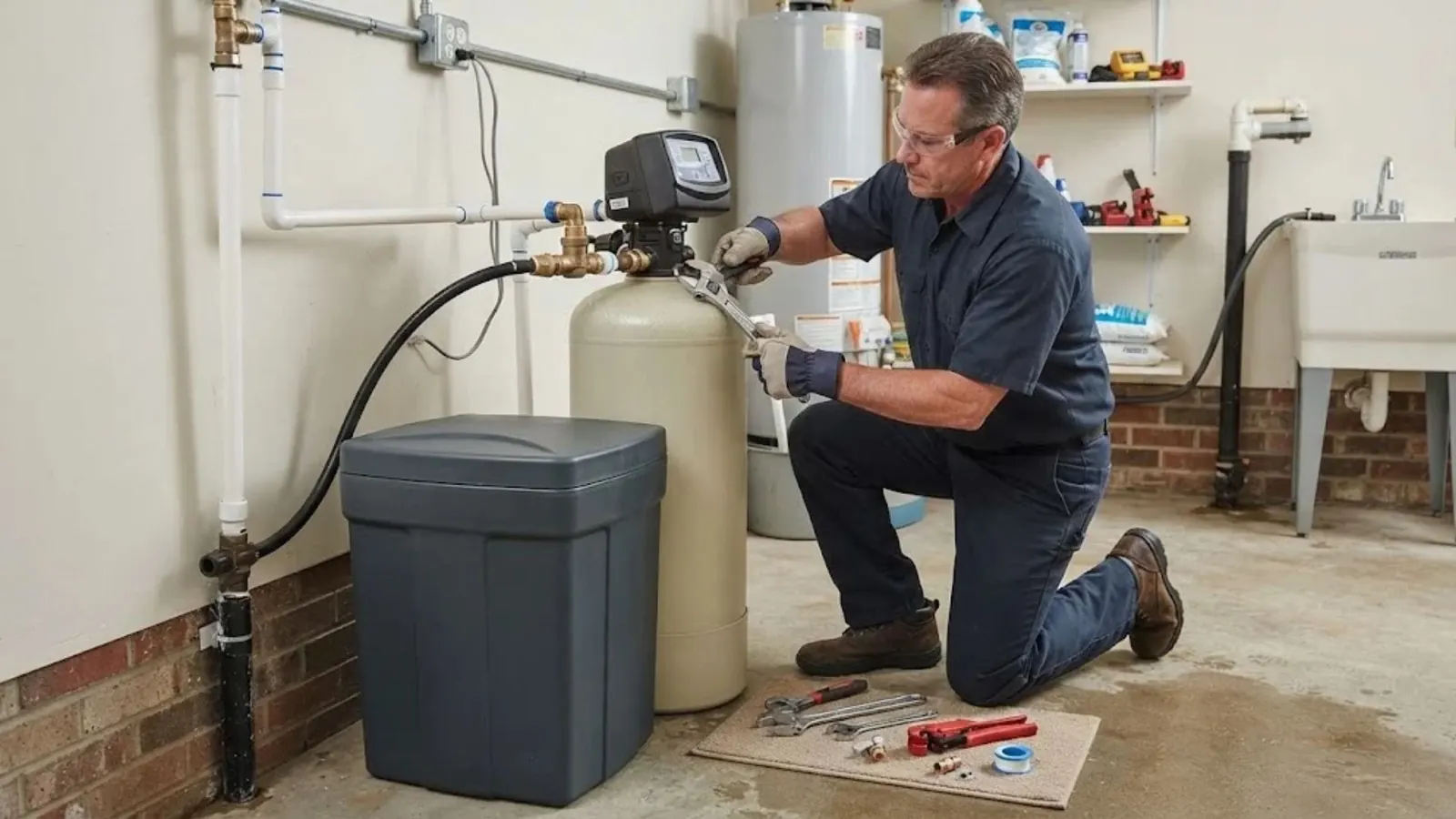
The best place for a water softener is where it can treat all the water that needs it, with room to service it and a drain close by. In many houses, that means the garage or a utility closet near the main shutoff. In others, the layout makes it harder.
This guide lays out the factors that decide where a softener goes in a San Bruno home, and what to check before you buy.
Start with the water, not the equipment
Before choosing a spot, confirm you need a softener. The city's 2023 water quality report lists local groundwater at an average of 215.6 ppm hardness and regional water at an average of 46 ppm. Your tap may be anywhere between those numbers.
Test your water, or ask us to. If it tests soft, the best location for a softener is no location at all. See water softener for how we approach that decision.
What the location needs
| Requirement | Why it matters |
|---|---|
| Access to the main line | The softener connects after the main shutoff and regulator |
| Drain within reach | Regeneration discharges brine and rinse water |
| Electrical outlet | The control head needs power |
| Space for salt | Brine tanks need room to open and refill |
| Protection from freezing and sun | Plastic components degrade in extreme conditions |
| Level, solid floor | A full brine tank is heavy |
Best locations in practice
A garage next to the water heater is the most common choice. The main line often passes through it, a drain is nearby and there is space for salt bags. A utility closet works if there is a drain and enough clearance.
Basements are ideal where they exist. Slab homes and townhouses with limited space may need a compact unit or a creative layout.
Bypass and outdoor taps
A bypass valve lets you route water around the softener for service. Outdoor hose bibs and irrigation lines are usually connected before the softener, since lawns and gardens do not need soft water. Softened water is also heavier in sodium, which some plants dislike.
We plan the split when we design the install, so the softened line feeds only the indoor fixtures.
Softener and water heater together
The softener should come before the water heater. That protects the tank and elements from scale. If your heater is failing from scale, see water heater repair. If you are planning a new heater, see water heater installation and decide on the softener at the same time.
On a tankless heater, softened water is even more valuable, because scale inside the heat exchanger shortens its life quickly.
Chloramine and carbon
San Bruno's water is disinfected with chloramine. A salt-based softener does not remove it. If taste or smell bothers you, a carbon filter handles that. Some whole-house systems combine both, in separate tanks.
We explain which problems each part solves, so you pay only for what you need.
Installation steps
- Choose the spotWe check the main line, drain, power and clearances.
- Cut in and plumbWe install a bypass, connect the inlet and outlet and run a drain line.
- Program and testWe set hardness and regeneration, then check flow and leaks.
- Show you the basicsWe explain salt, the bypass and what to watch for.
Permits and code
Softener installation touches the water supply and the drain, so check local rules. Ask the Building Division what applies at your address, and make sure the drain connection includes an air gap where the code requires.
A layout checklist
A softener needs a short list of things, and they are easier to arrange before the unit is delivered. Think about where the main water line enters, where the nearest drain is and where you can plug it in. Those three facts usually decide the spot.
The unit also needs room to be reached for salt and service. A cabinet that traps heat or a space that freezes is a poor choice, since the resin tank can be damaged by freezing.
- Install it after the main shutoff and before the water heater.
- Provide a bypass valve so the unit can be isolated for service.
- Run the drain line to an approved drain with an air gap.
- Use a grounded outlet within reach of the control head.
- Leave space around the brine tank for salt loading.
- Keep the unit out of direct sun and freezing temperatures.
What to leave on hard water
Many homeowners leave outdoor hose bibs and a kitchen cold tap on hard water, because softened water is not ideal for drinking in some cases and wastes softener capacity on irrigation. Your plumber can split the lines so the softener serves the house but not those taps.
Whether this makes sense depends on your hardness and taste. For data on local water, see your utility's quality report. See water softener for sizing and installation, and water heater repair for scale-related heater problems.
Working out the right size first
Location comes after size. A softener is sized by the grains of hardness it must remove between regenerations, which depends on how hard your water is and how much your household uses. An oversized unit wastes salt and water. An undersized one regenerates too often.
Ask your utility for the current hardness figure for your address, and count the people and bathrooms. A good installer will do that math with you, then choose the spot that fits the unit.
Hardness changes from town to town, so a layout that suits a San Bruno home on groundwater may be more than a house in Burlingame needs, since that city buys only regional system water.
Plumbing problem that cannot wait?
Call the 24/7 line. A dispatcher answers and starts with the first steps.
San Bruno water numbers
The City of San Bruno's 2023 Water Quality Report lists the city's local groundwater at an average hardness of 215.6 ppm, with a range of 158 to 324 ppm, and a pH of 7.27. San Francisco Regional Water System water averaged 46 ppm. The city's supply was 29 percent groundwater in 2023, and the water is disinfected with chloramine.
Hardness is reported as calcium carbonate. The city's Water Division can be reached at (650) 616-7162, and its water quality supervisor at (650) 616-7174. In South San Francisco, Cal Water reports groundwater hardness averaging 384 ppm, so the gap between source waters is even larger there.
Source type: City of San Bruno 2023 Water Quality Report and Cal Water Bayshore District report. Facts are stated according to each agency's own published page.
Questions about this topic
On the main water line after the shutoff and the pressure regulator, and before the water heater. It needs a drain connection and an electrical outlet.
Usually not. Hose bibs are normally left on unsoftened water to save salt and avoid softened water on lawns.
Yes. During regeneration, the softener flushes brine and rinse water to a drain. A floor drain, a standpipe or a laundry sink can serve, provided it meets code.
Slightly. A softener adds a small pressure drop. A properly sized unit should not be noticeable, and we check flow after installation.