Hard water leaves white crust on faucets, cloudy spots on glasses and scale inside water heaters. Whether it affects your home depends on which water reaches your tap. San Bruno blends surface water from the San Francisco Regional Water System with water from the city's own wells, and the two differ a lot.
This page explains what the city's numbers say, how to test your own water and when a softener or filter is worth installing. It is a planned service, not an emergency one.
What the city's water quality report says
These figures come from the City of San Bruno 2023 Water Quality Report. Hardness is reported as calcium carbonate. The report also lists a groundwater pH of 7.27 and chloramine as the disinfectant, with a running annual average of 2.86 ppm.
The report does not give hardness in grains per gallon. Using the standard conversion of about 17.1 ppm per grain, the groundwater average is roughly 12.6 grains per gallon. That conversion is ours.
The ranges above are a common classification. Your tap may sit anywhere between the two source averages depending on your street and the time of year.
How to know what you actually have
- Look for signs: white crust on faucets, spotted glassware, soap that does not lather.
- Use a hardness test strip or ask us to test a sample from your kitchen tap.
- Ask the city's Water Division which sources serve your area.
- Check your water heater. Heavy scale in the drain water is a sign.
Want your water checked?
Call and we will test a sample and explain the result.
Softener, filter or neither
| Goal | Option | Notes |
|---|---|---|
| Reduce scale on heaters and fixtures | Salt-based softener | Removes calcium and magnesium |
| Remove chloramine taste and odor | Carbon filtration | Softeners do not remove it |
| Drinking water only | Under-sink filter | Smaller, cheaper |
| Low or moderate hardness | Nothing, or a periodic flush | No equipment needed |
Where a softener goes and what installation involves
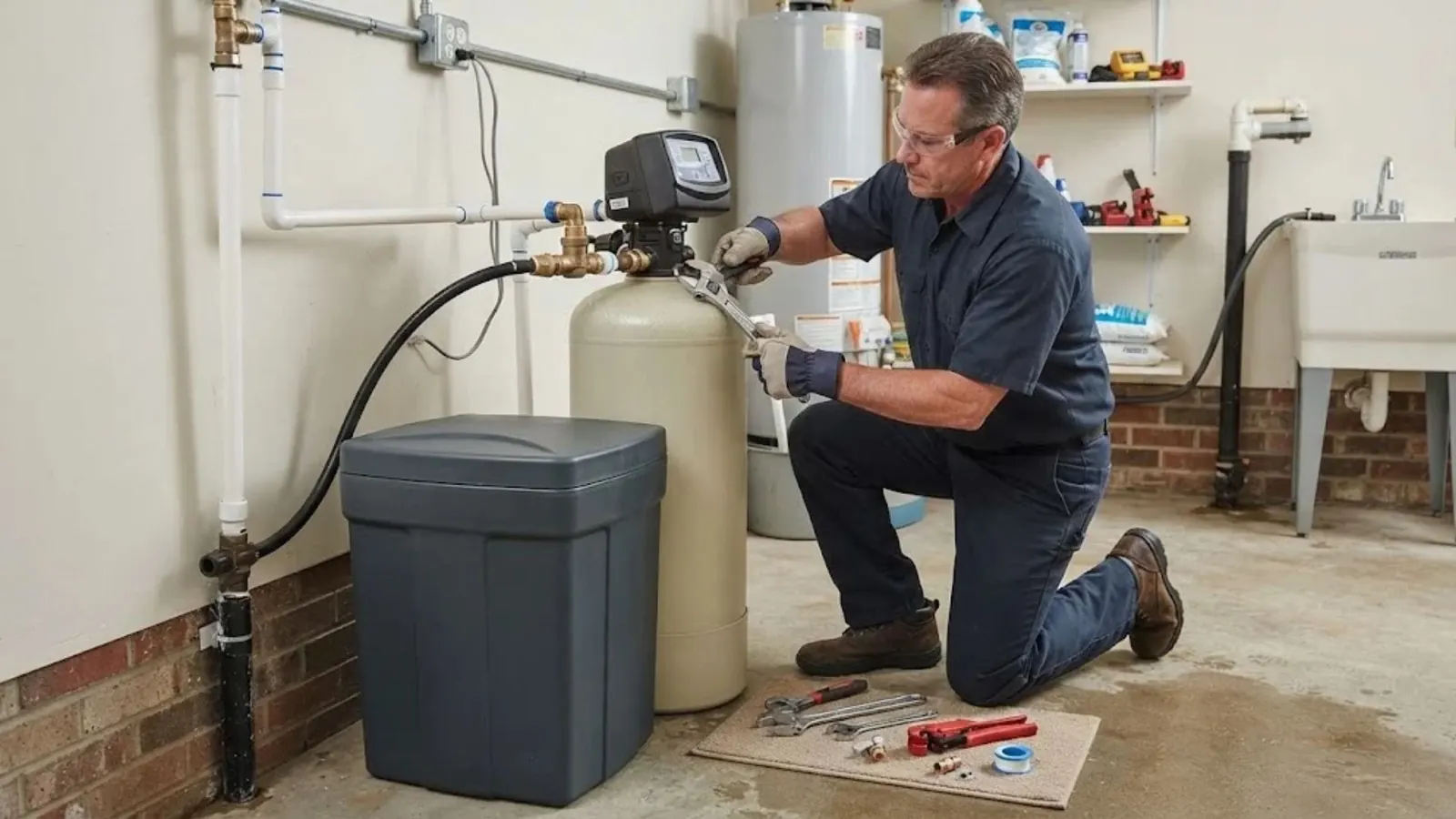
A softener is installed on the main water line after the shutoff and before the water heater, with a drain connection for regeneration and an outlet for power. Outdoor hose bibs are usually left on hard water.
We plan the location, the bypass valve, the drain and the electrical. Some installs include a pressure check, since a softener adds a small pressure drop.
Who benefits most
Households that rely on a tank water heater benefit the most, since scale shortens tank life and reduces efficiency. A tankless heater needs even more protection, as its heat exchanger fouls quickly in hard water. See tankless water heater for the details.
If your heater is failing from scale, see water heater repair. We will not push equipment where the numbers do not support it.
What affects water softener cost
Equipment and installation each change the price.
- System sizeCapacity depends on hardness and household size.
- TypeSalt-based, salt-free conditioners and filters differ in cost and effect.
- Plumbing changesA drain and bypass may need new connections.
- ElectricalMost units need a nearby outlet.
- Ongoing costsSalt, filter cartridges and occasional service.
Want your real number? Call (650) 860-1670.
Homes in South San Francisco face an even larger gap between source waters, since Cal Water's report lists its groundwater above 300 ppm on average.
What the city's numbers say
According to the City of San Bruno's 2023 water quality report, local groundwater hardness averages 215.6 ppm and the regional supply averages 46 ppm. The mix at your tap depends on where you live in the city.
A softener's drain connection must meet the plumbing code, and the Building Division at 650-616-7058 can confirm what applies.
Frequently asked questions
It depends on the source at your tap. The city's 2023 water quality report lists its local groundwater at an average of 215.6 ppm hardness as calcium carbonate, with a range of 158 to 324 ppm. Water from the San Francisco Regional Water System averaged 46 ppm. The city said groundwater made up about 29 percent of supply in 2023, so the blend varies.
Use a hardness test kit or ask us to test it. You can also ask the San Bruno Water Division, which can be reached at (650) 616-7162, which parts of the city receive more groundwater.
One grain per gallon equals about 17.1 ppm, so 215.6 ppm works out to roughly 12.6 grains per gallon. That is our own conversion, since the city report gives ppm only. By common scales, that is hard to very hard.
No. A salt-based softener removes calcium and magnesium. San Bruno's water is disinfected with chloramine, and removing it needs carbon filtration. We can explain both.
Only if hardness causes a problem for you, such as scale on fixtures, short heater life or spotted dishes. If your tap tests soft or moderate, we will say so.