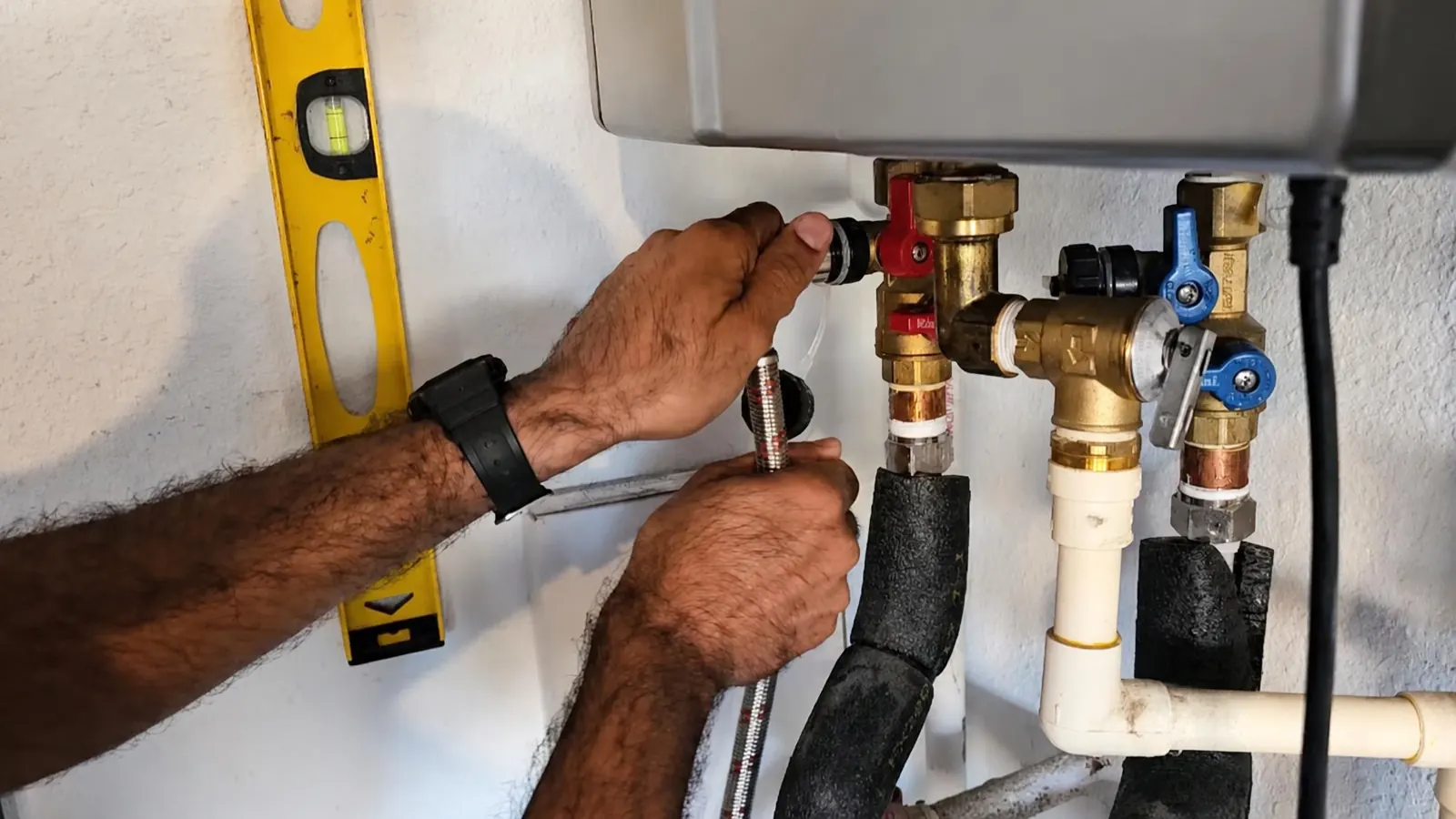
A tankless water heater heats water as it flows instead of storing it, so it never runs out when the demand is within its flow rating. It also asks more of the home. Gas line size, venting, a condensate drain and hard water scale all shape how well it works.
We install, repair and flush tankless units. This page covers all three, since the three jobs share the same hardware and the same local water chemistry.
Tankless water heater installation
Installation starts with a load calculation. We total the flow of fixtures you might run at once, then compare it to the unit's output at your incoming water temperature. Cold-water temperature matters, and a unit that handles a hot bath in summer may struggle in winter.
Next comes the gas line. Tankless units often need a larger gas pipe, and the meter must deliver enough volume. Venting follows. Most use stainless or PVC through a wall or roof, and the manufacturer's clearances are strict.
| Item to check | Why it matters |
|---|---|
| Gas pipe and meter capacity | The unit draws a large load when it fires |
| Vent type and run length | Wrong vent material or long runs cause errors and safety risks |
| Electrical outlet | Controls and fans need power, even on gas units |
| Condensate drain | Condensing units drip acidic water that must go to a drain |
| Isolation valves | They let the unit be flushed without cutting water to the house |
| Recirculation line | Optional, shortens the wait for hot water at distant fixtures |
Tankless flush and descale
Scale is the enemy. As water heats in the narrow passages of the heat exchanger, dissolved minerals drop out and coat the metal. The coating insulates the exchanger and raises the temperature required to deliver the same output. Eventually the unit overheats, throws codes or loses flow.
A flush runs a descaling solution through the unit with a small pump, then rinses with clean water. We also clean the inlet screen. In hard water areas, many manufacturers call for yearly service, and your manual is the final word.
Why local water chemistry matters here
The city's 2023 report shows local groundwater at 215.6 ppm hardness, with a range of 158 to 324 ppm. San Francisco Regional Water System water is softer, averaging 46 ppm. The city says groundwater made up about 29 percent of its supply in 2023, so the blend at a particular tap changes.
That variability is the reason we recommend testing your tap instead of guessing. If your water is hard, a water softener or a regular flush schedule protects the heat exchanger.
Questions about a tankless upgrade?
Call and tell us about your gas line and how many fixtures run at once.
Tankless water heater repair
The display code is the first clue. Ignition failures point to gas supply, the igniter or flame rod. Overheat codes often mean scale. Flow errors can come from a clogged inlet screen or a failing sensor. Vent errors may mean a blocked termination or a condensate problem.
If the unit is a leaking tankless heater, shut off the water and gas to it and call us. A leak can come from a loose fitting, a failed heat exchanger or a clogged condensate trap. We find the source before recommending repair or replacement.
Venting and exhaust
The vent carries combustion gases out of the home, and mistakes are dangerous. We check for proper slope on condensing vents, sealed joints, clearances from windows and a clear termination. A bird nest or snow drift in a termination will shut a unit down.
If you are replacing a tank with a tankless unit, the old chimney flue usually cannot be reused. A new vent path is part of the plan.
What affects tankless water heater cost
Tankless jobs vary widely, so the price is set after we see your home.
- Unit size and brandOutput and efficiency drive the equipment cost.
- Gas line upgradeA larger pipe or a meter change adds labor.
- VentingA short wall vent is simple. A roof run or a long vent costs more.
- Electrical and drainPower outlet, condensate line and recirculation add small jobs.
- Service typeA flush is a modest visit. A new install is a larger one.
Want your real number? Call (650) 860-1670.
If a tank is failing and you want hot water today, see water heater replacement. For a planned tank install, see water heater installation. We also serve Pacifica, where the water is softer.
What to do if a tankless unit acts up
- If you smell gas, leave the building and call 911, then PG&E at 1-800-743-5000.
- Do not relight or reset the unit repeatedly when an error code returns.
- Turn off the gas valve and the water valve if the unit leaks.
- Keep the area around the vent clear of stored items.
- Call us with the error code you see on the display.
Gas safety and manufacturer guidelines
Venting and gas sizing follow the maker's installation manual and the California Plumbing Code. The manual's guidelines override any rule of thumb.
According to PG&E's gas safety guidance, if you smell gas, leave the area, call 911 and then call PG&E at 1-800-743-5000. Keep carbon monoxide detectors working in any home with gas appliances.
Frequently asked questions
Many manufacturers call for a yearly flush, and hard water is the reason. Check your manual for the exact interval. The flush circulates a mild descaling solution through the heat exchanger and then rinses it. We use isolation valves so the job is a quick visit.
The city's 2023 water quality report lists San Bruno groundwater at an average of 215.6 ppm hardness as calcium carbonate, and San Francisco Regional Water System water at an average of 46 ppm. What reaches your tap depends on where you live in the city and the season, so test your tap or ask the water division.
Common causes are scale in the heat exchanger, a clogged inlet filter, a blocked vent or condensate drain, low gas supply and flow sensors that stick. The code on the display points us to the area. We read it, test the unit and repair it when it is cost-effective.
High-efficiency condensing tankless units cool exhaust gas enough to form acidic water. A small drain line, often with a neutralizer, carries it away. If it clogs, the unit may shut down. We check it on every service visit.
Often not. Tankless units draw more gas at once than a tank. We check your gas meter capacity and pipe size before quoting, since a too-small line is a common reason a tankless install fails to perform.