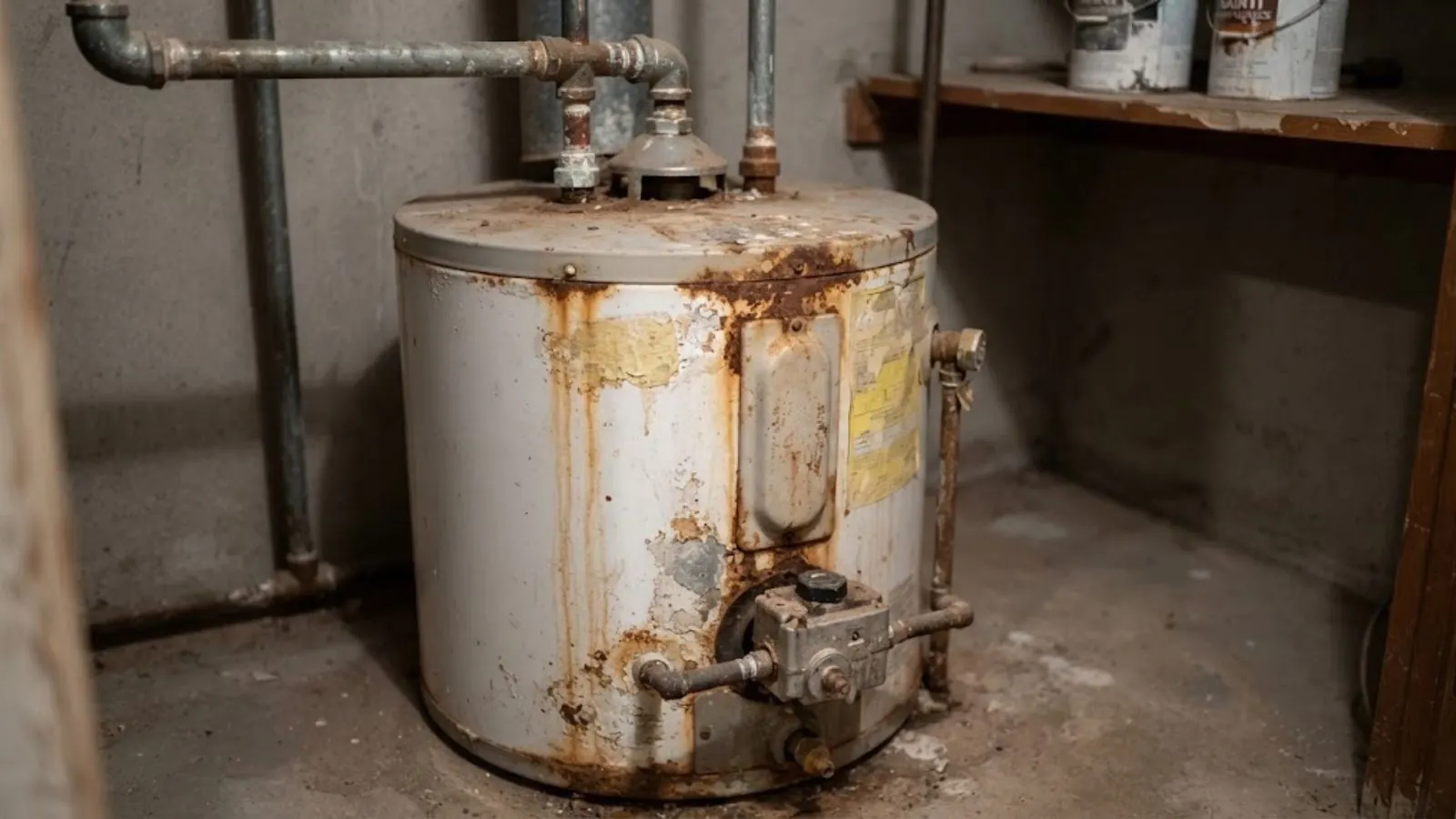
When a tank has rusted through, the question is not repair but how fast you can get hot water back. If your heater is leaking from the base, shut off the cold supply valve and power or gas, then call. We answer 24/7 and plan same-day replacement when stock allows.
Tell us the heater's fuel, size and the room it sits in. A photo of the data plate lets us line up the right unit before we arrive.
Failed water heater: what to do first
- Shut off the cold water to the heater and turn off power or gas.
- Drain a few gallons through the drain valve if water is still pooling, using a hose to a safe spot.
- Move boxes, paint and stored items away from the area.
- Take a photo of the data plate and the leak.
- Call us and say whether you want the same fuel type or are considering a change.
Repair or replace: a decision guide
| Situation | Usually best | Reason |
|---|---|---|
| Tank body leaking | Replace | The steel has failed and cannot be patched |
| Tank near ten years old, failing part | Replace | Another part will likely fail soon |
| Tank under five years, bad thermostat or element | Repair | The tank is sound |
| Rusty water and a corroded anode | Inspect, often replace | The tank may be rusting from the inside |
| Frequent repairs | Replace | Repair costs add up and reliability drops |
Choosing the right replacement
Size matters. A household of two or three often does well with a 40 to 50 gallon tank. Larger families use 50 to 75 gallons, and a unit that is too small runs out of hot water at the worst time.
Fuel matters too. Gas heaters recover quickly, electric units are simple to install and heat pump hybrids use less electricity. We will explain what your home's gas line, panel and ventilation allow.
Local rules: straps, permits and the air district
California law requires water heaters to be braced, anchored or strapped against earthquake movement. We install strapping on every replacement. Fixed vents, discharge pipes and drain pans are part of the install too.
San Bruno adopts the 2025 California Plumbing Code under section 11.20.010 of its municipal code, and the building official is the administrative authority. Permit rules vary, so ask the Building Division. In the Bay Area, the air district's zero-NOx rule for new residential water heaters was scheduled for January 2027, and the district said draft amendments would move it to January 2028. Check baaqmd.gov for the current date before you buy.
Need hot water back today?
Call 24/7. We will tell you what is available and what the install involves.
Tank or tankless?
Tankless units save space and heat water on demand, but they cost more up front and need adequate gas supply and venting. A tank is cheaper to install and simple to service. If you are weighing a switch, see tankless water heater for the trade-offs.
For a planned upgrade without an emergency, water heater installation covers relocations, fuel changes and new venting.
Old tanks, hard water and sediment
San Bruno's groundwater averaged 215.6 ppm hardness in the city's 2023 report. In a tank, that hardness settles as scale on the floor and around the heating elements. Over years it cuts efficiency and can cook the tank bottom.
If your old heater was crusty when we drained it, we will talk about a softener or a simple annual flush for the next one.
What affects water heater replacement cost
Total cost is the unit, the labor and any code corrections.
- Tank size and fuelA 50 gallon gas heater costs more than a 40 gallon electric one.
- Efficiency and typeHeat pump and tankless units cost more up front.
- Venting and gas lineChanging vent types or gas pipe size adds labor.
- Code itemsStraps, an expansion tank, a drain pan and a discharge pipe are part of a proper install.
- Permit and haul-awayPermit steps and disposal of the old unit are quoted with the job.
Want your real number? Call (650) 860-1670.
We install and replace heaters across South San Francisco too, where the hardness story is even more pronounced.
Code points that apply to a replacement
California Health and Safety Code section 19211 requires bracing for new and replacement water heaters, and the California Plumbing Code sets the minimum. San Bruno adopts the 2025 code under section 11.20.010.
A replacement is normally permitted work. We explain who files the permit and how the inspection happens before the day of the install.
Frequently asked questions
Yes. When a tank has failed and the house has no hot water, call the 24/7 line. We assess whether the unit can be saved. If it cannot, we plan a replacement, and same-day installs are often possible when the right unit is in stock.
A leak from the tank body, rusty hot water, rumbling that persists after flushing, repeated repairs and an age near or beyond ten years are all signs. Check the date on the data plate, where the serial number often shows the year.
Permit rules vary, so ask the San Bruno Building Division. It runs the SB Permits online system and can be reached at 650-616-7058. We handle the permit steps for installs we perform and will tell you what applies at your address.
The Bay Area Air Quality Management District adopted a zero-NOx standard for residential water heaters under Rule 9-6. The district's page says it applies to new water heaters at the time of replacement, not to existing units, and that draft amendments from 2026 would delay the date to January 2028. Those amendments were not final on the page we reviewed, so confirm the current date with the district.
Most standard tank replacements take a few hours, including draining the old unit, setting the new one, connecting water, gas or power, venting, strapping and testing. Moving the heater or changing fuel types takes longer.