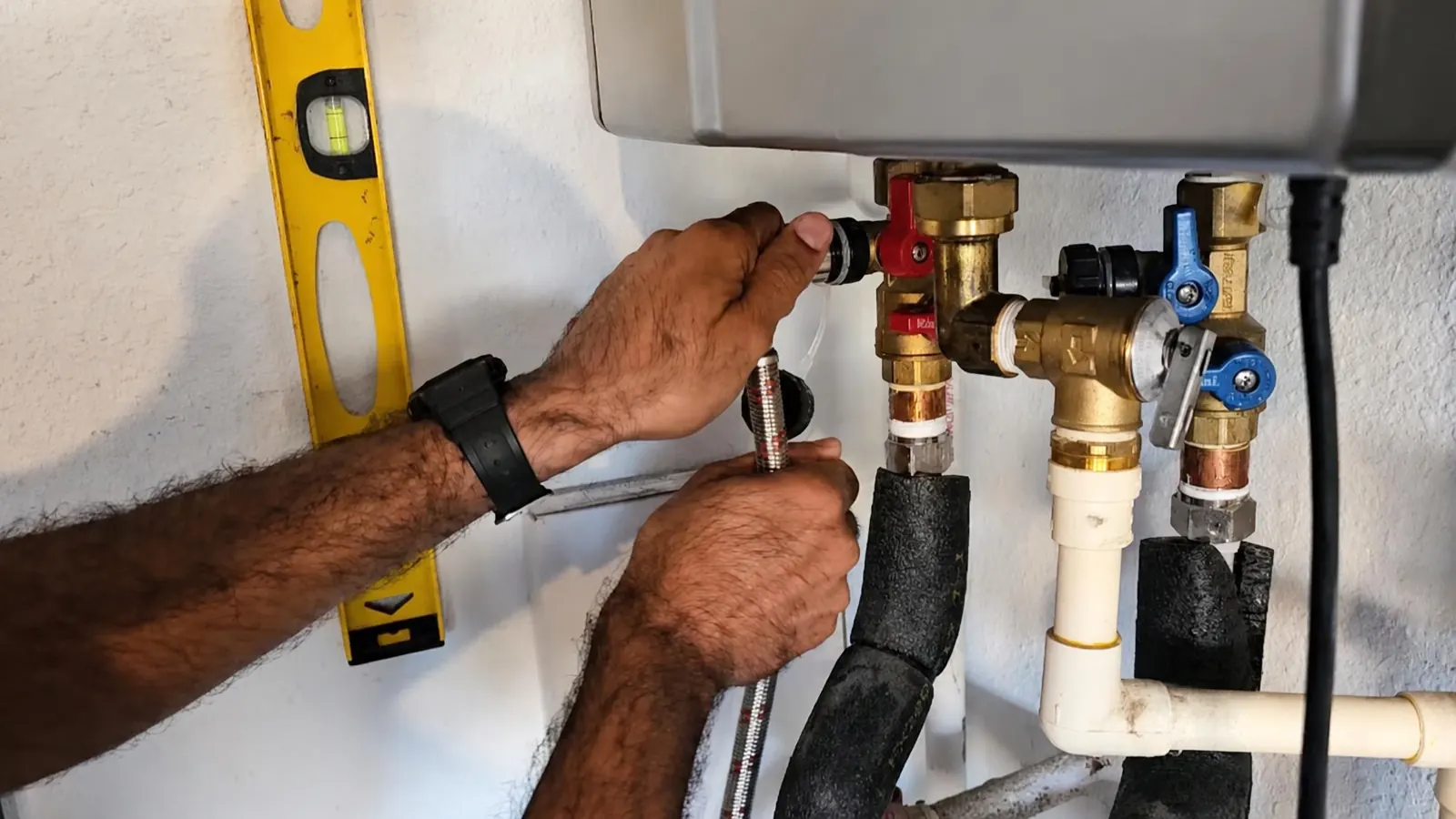
A tankless water heater has far less water inside than a tank, so a leak looks smaller. That does not mean it is harmless. A drip can come from a loose fitting, but it can also signal a cracked heat exchanger or a blocked condensate line. If you see water, turn off the water and gas to the unit and find where it is coming from.
This guide helps you narrow the source and decide what to do next.
First steps when a tankless heater leaks
- Turn off the gas and the power to the unit.
- Close the cold water isolation valve.
- Place a bucket or towel under the leak.
- Look at the water's source: a fitting, the bottom of the unit or the drain line.
- Take a photo and call a plumber.
Where the water is coming from
| Leak location | Likely cause | Typical response |
|---|---|---|
| At a pipe fitting | Loose connection or worn washer | Tighten or replace the fitting |
| At the pressure relief valve | High pressure or a worn valve | Check pressure, replace the valve |
| At the condensate line | Clogged trap or neutralizer | Clear the line and clean the trap |
| Inside the cabinet | Cracked heat exchanger or internal fitting | Professional diagnosis, possible replacement |
| At the isolation valves | Worn valve seals | Replace the valve |
Condensate: normal water or a problem?
Condensing tankless units produce acidic condensate as exhaust cools. A small drain line carries it to a drain, often through a neutralizer cartridge. If the line clogs, condensate backs up inside the unit or overflows.
Cleaning the line and the trap is a routine part of a service visit. If you see a steady drip and the unit shows an error, the condensate line is the first thing we check. See tankless water heater service for what a visit includes.
Heat exchanger failures
The heat exchanger is the copper or stainless component that transfers heat to the water. Scale, a freeze or years of stress can crack it. A cracked exchanger leaks inside the cabinet and may trigger error codes.
Replacement can cost a large fraction of a new unit, so on older heaters we may recommend replacement. We always explain the numbers before recommending it.
Why hard water matters
Scale builds inside the heat exchanger and slows heat transfer. The unit then runs hotter to deliver the same temperature, and the added stress shortens its life. A yearly flush with descaling solution keeps it clean, and a softener helps at the source.
If your tankless heater is more than a few years old and never flushed, expect scale. That is the most common cause of premature failure.
When to call a plumber
Call if water is inside the cabinet, if there is a gas smell or if the unit throws repeated error codes. Gas and water do not mix, and a leaking cabinet can short out electronics. For a unit that is only dripping from a visible fitting, a plumber can usually fix it quickly.
If the water heater is more than 15 years old, ask about replacement. See water heater repair for the general approach.
Preventing future leaks
- Flush the unit on the schedule in the manual.
- Clean the inlet screen at each service.
- Keep the condensate line clear.
- Check isolation valves for drips once a year.
- Install a pressure regulator if your water pressure runs high.
Where a tankless leak usually starts
| Location | Typical cause | First response |
|---|---|---|
| Water connections at the bottom | Loose or worn fittings, failed seals | Shut off water and gas, then call |
| Isolation valves | Worn valve seals or packing | Close the valves and call |
| Pressure relief valve | High water pressure or thermal expansion | Call, do not plug the valve |
| Condensate line | Clogged trap or neutralizer | Clear the drain path or call |
| Inside the cabinet | Cracked heat exchanger from scale or freezing | Stop using the unit and call |
| Inlet filter | Loose filter cap or damaged O-ring | Turn off water, inspect the cap |
What to do in the first ten minutes
- Turn off the gasUse the shutoff valve on the gas line to the unit. If you smell gas, leave the house and call 911 first.
- Close the water supplyShut the cold water valve feeding the heater. If it does not close, shut the main valve.
- Cut the powerUnplug the unit or switch off its breaker, but only if the area around the outlet is dry.
- Catch the waterPut a bucket under the drip and mop the floor to prevent slipping and damage.
- Call a plumberDescribe where the water is coming from and whether it is hot or cold.
A leak inside the cabinet can mean the heat exchanger is damaged. That is a major repair and sometimes the end of the unit's life. A drip at a fitting is a simpler repair. A technician finds out which one you have in a short visit.
See water heater repair for the diagnosis process. If the unit is old and the exchanger is cracked, replacement may be the better path.
Preventing the next leak
Flush the unit once a year, especially where water is hard, because scale is a leading cause of heat exchanger failure. Keep the condensate path clear. Check the isolation valves and filter for drips during that flush. Small drips are easier to fix than a soaked wall.
If you are unsure whether a damp spot is a leak or condensation, wipe it dry and check again in an hour. A repeat of the wetness points to a leak, and a plumber should look at it before you run the unit again.
The steps are the same for a unit in Daly City or Millbrae, and our dispatch covers both from the San Bruno office.
Plumbing problem that cannot wait?
Call the 24/7 line. A dispatcher answers and starts with the first steps.
San Bruno water quality and your tankless heater
The City of San Bruno's 2023 Water Quality Report lists local groundwater at an average hardness of 215.6 ppm as calcium carbonate, with a range of 158 to 324 ppm. The same report lists San Francisco Regional Water System water at an average of 46 ppm. The city said groundwater made up 29 percent of its 2023 supply.
The report also says the water is disinfected with chloramine. It does not state hardness in grains per gallon. To find your own number, contact the Water Division at (650) 616-7162 or test your tap. The same blended water supplies homes in South San Francisco in part, where Cal Water reports even harder groundwater.
Source type: City of San Bruno 2023 Water Quality Report. Facts are stated according to each agency's own published page.
Questions about this topic
Leaks come from loose fittings, a failed pressure relief valve, a cracked heat exchanger or a clogged condensate line that overflows. The leak location tells us which.
A fitting or valve leak is usually repairable. A cracked heat exchanger is expensive and often leads to replacement, especially on an older unit.
On a condensing unit, yes. Condensation is a normal byproduct and should drain away. If it overflows or backs up, the line is blocked.
Scale can overheat the heat exchanger and shorten its life, which can lead to a leak. It can also clog valves and flow sensors. That is why many manufacturers call for periodic flushing.