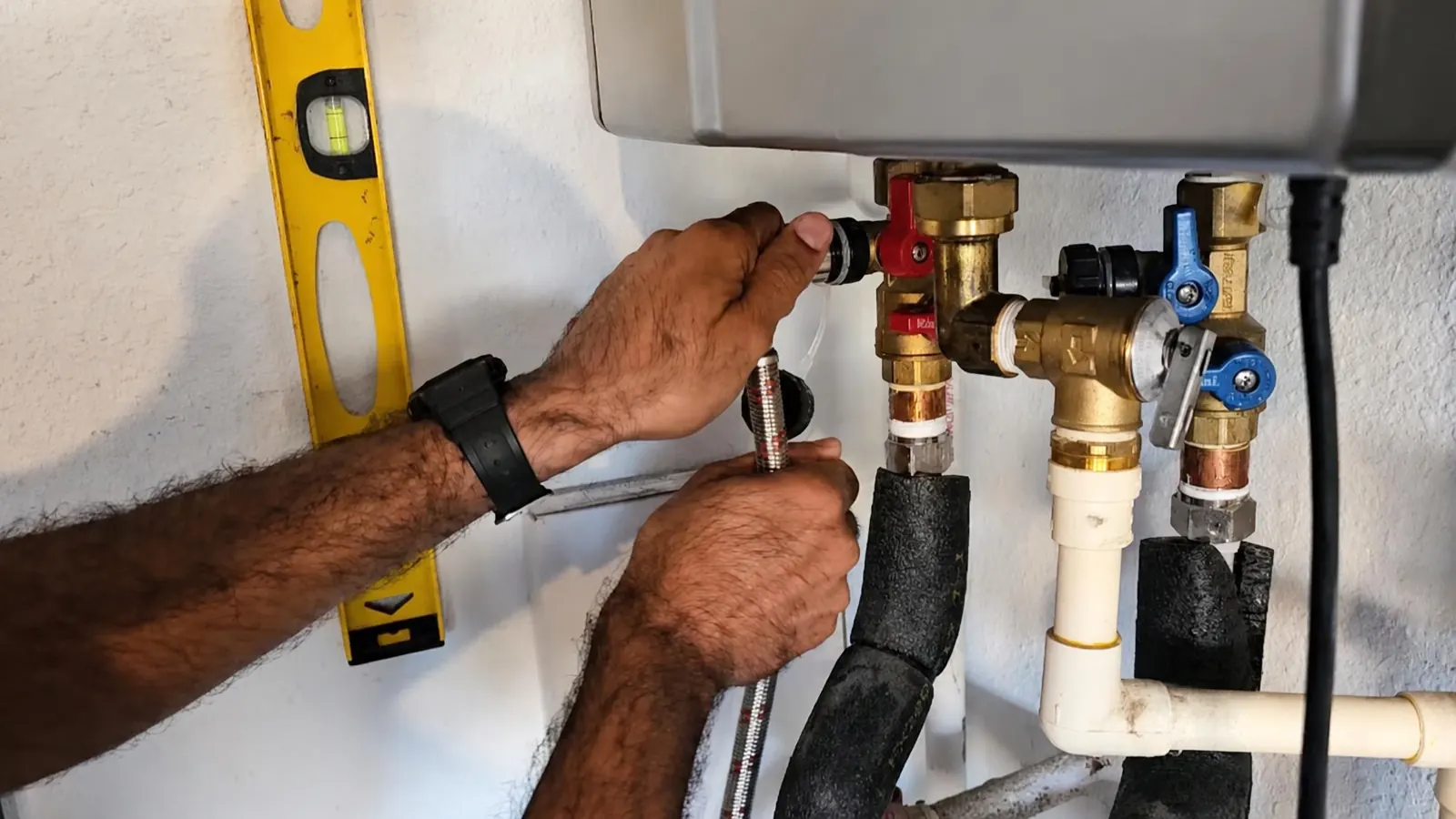
A high-efficiency tankless water heater cools its exhaust so much that water vapor condenses inside the unit. That liquid is called condensate, and it needs a place to go. When it does not, the heater throws errors, leaks or shuts down.
This guide explains what condensate is, how it is handled and what to check when a unit backs up.
What condensate is
When gas burns, it makes water vapor along with carbon dioxide. A standard heater sends that vapor up the flue as steam. A condensing heater extracts extra heat from the exhaust, which cools it below the dew point, and some of the vapor turns to liquid.
The liquid is slightly acidic, with a pH often between 3 and 5. That is why the drain line and the neutralizer matter.
How the condensate system works
| Part | Job |
|---|---|
| Condensate trap | Holds a water seal so exhaust does not escape into the drain line |
| Drain line | Carries condensate away by gravity |
| Neutralizer | Raises the pH of the condensate before it enters the drain |
| Condensate pump | Lifts the water when a gravity drain is not possible |
| Float switch | Stops the unit if the condensate backs up |
Common condensate problems
- A clogged trap from scale or debris.
- A kinked or sagging drain line that holds water.
- A neutralizer that has been used up.
- A failed condensate pump or float switch.
- A frozen or blocked outdoor termination in cold climates.
Any of these can trigger an error code, stop the heater or cause a leak. The fix is usually simple once the cause is found.
Where the line should drain
The best drain is a floor drain, a laundry standpipe or a utility sink, with an air gap where required. Do not run condensate into a drain that leads to a septic tank without checking the manufacturer's guidance and local rules.
If a gravity drain is not available, a small condensate pump lifts the water to a drain. These pumps fail from time to time, so we check them on service visits.
Service steps we take
- Inspect the lineWe trace the line from the unit to the drain, checking slope and connections.
- Clean the trapWe remove and rinse the trap and the line.
- Check the neutralizerWe test the pH and refill the media if it is spent.
- Test the safetiesWe verify the float switch and pump, then run a cycle.
Condensate and hard water
Scale can clog the trap and the line as well as the heat exchanger. A yearly flush keeps the unit clean, and a softener reduces scale at the source. See tankless water heater for install, repair and flush service.
If the unit shows an error and the condensate line is dry, the cause is elsewhere, such as the vent or the gas supply. We check all of them.
When to call
Call if the unit leaks, shows repeated errors or smells of exhaust. Do not run a heater that is leaking inside the cabinet. For installs, see water heater installation to plan the drain from the start.
Neutralizer media and checking pH
A neutralizer is a small canister filled with calcium carbonate or a similar material. Acidic condensate passes through, and the material dissolves slowly, raising the pH. Over time the media is used up and must be topped off or replaced.
You can check the cartridge with pH test strips. Condensate that tests very acidic after the neutralizer means the media is spent. Many manufacturers give a schedule, and heavy use shortens it. We test the discharge on each service visit.
Pumps, routing and freezing
If the unit sits below the nearest drain, a condensate pump lifts the water. The pump has a small reservoir, a float switch and a discharge line. Most failures come from debris in the reservoir or a stuck float.
Routing matters too. The line should slope continuously downhill with no low spots where water sits. A trap formed by a sag can block flow. Secure the tubing so it cannot kink.
| Symptom | Check first |
|---|---|
| Error code and no heat | Condensate trap and float switch |
| Water on the floor under the unit | Drain line connections and the pump |
| Gurgling from the unit | A partial blockage in the line |
| Sour smell near the drain | A dry trap or spent neutralizer |
Condensate problems are usually quick to fix once found. Keeping up with an annual service prevents most of them. See tankless water heater for the service we offer.
A seasonal check that takes ten minutes
- Look at the drain pathFollow the tube from the unit to the drain and check for kinks or sags.
- Listen for the pumpIf you have a pump, pour a little water in the reservoir and confirm it runs.
- Smell and lookA sour smell or white crust at the trap can mean a leak or spent media.
- Note error codesWrite down any code so a technician can match it to the history.
This check does not replace an annual service. It does catch small problems before they turn into a leak on the floor.
Plumbing problem that cannot wait?
Call the 24/7 line. A dispatcher answers and starts with the first steps.
San Bruno drains and who to ask
San Bruno adopts the 2025 California Plumbing Code under section 11.20.010 of its municipal code, and the building official is the administrative authority. The Building Division can be reached at 650-616-7058. The code is the place to confirm where acidic condensate may be discharged, and local amendments matter.
The city's Utility Billing page says that sewer charges moved to the San Mateo County property tax bill on July 1, 2024, which tells you that the sewer service is the city's even though the charge appears elsewhere. Wastewater questions go to Public Works. The same condensate rules apply in nearby Pacifica and Daly City through their own building offices.
Source type: San Bruno Municipal Code Chapter 11.20 and Utility Billing web page. Facts are stated according to each agency's own published page.
Questions about this topic
Condensing tankless heaters cool the exhaust enough that water vapor turns to liquid. That condensate is a normal byproduct and must drain away.
It is mildly acidic, which is why many installs include a neutralizer cartridge. The acid can damage metal drain pipes and some disposal surfaces if left untreated.
Usually to a floor drain, a laundry sink standpipe or a condensate pump that lifts it to a drain. The line must slope down, with no kinks or dips that trap water.
Check the manufacturer's recommendation. Many cartridges need refilling with media on a schedule that depends on use. We check it on every service visit.