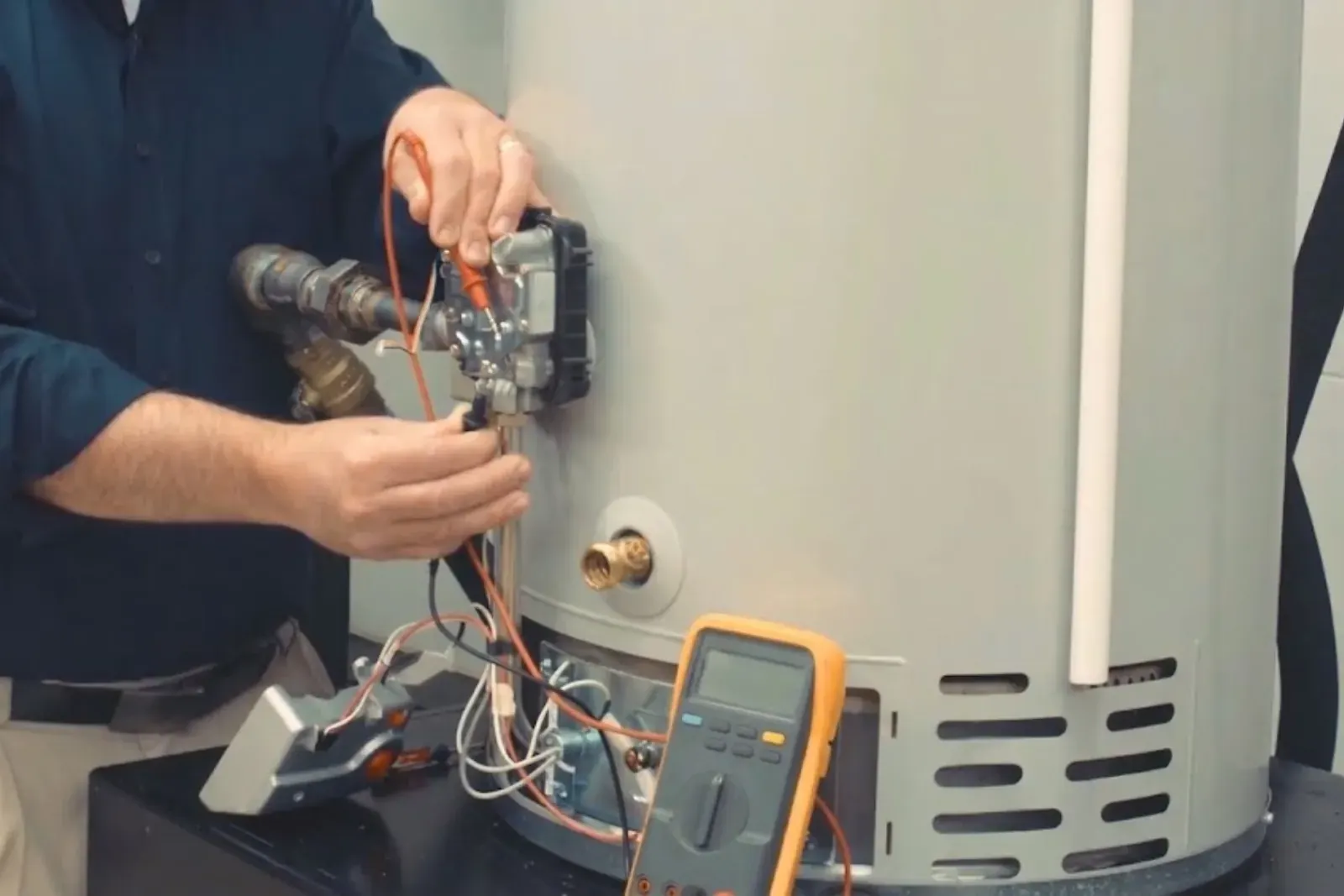
A water heater thermostat is a small part with a big job. It tells the heating element or the burner when to start and when to stop. When it fails, the symptoms are blunt: no hot water, water that is far too hot, or hot water that runs out in minutes.
This guide explains how the thermostat works on electric and gas units, how a plumber tests it and what a replacement involves. It is written for homeowners in San Bruno who want to understand the repair before they call.
How a water heater thermostat works
An electric tank has two thermostats, one near the top and one near the bottom, each wired to a heating element. The upper one takes priority. It heats the top of the tank first, then hands power to the lower element. Each thermostat reads the tank surface temperature through a metal clip.
A gas tank has a single control that combines the gas valve and the thermostat. A probe inside the tank senses temperature and opens or closes the gas flow to the burner. Both designs also have a high-limit cutoff that shuts the heater down if the water gets dangerously hot.
Signs the thermostat has failed
- Water is lukewarm or cold, and the breaker is on.
- Water is scalding even at a normal setting.
- The reset button on the upper thermostat keeps tripping.
- Hot water runs out quickly, then returns slowly.
- The temperature does not change when you move the dial.
Several of these symptoms also come from a failed element, a tripped breaker or sediment buildup. That is why a test comes before a part purchase.
How we test before replacing anything
On an electric unit, we turn off the breaker and confirm there is no power with a meter. We remove the access panels and insulation, then test the thermostat and element for continuity and resistance. A thermostat that does not click or does not switch at the right temperature is replaced.
On a gas unit, we check the pilot or igniter, the thermocouple and the gas control valve. If the control valve has failed, replacing it can cost close to a new heater, and that changes the decision. See water heater repair for how we weigh repair against replacement.
What a thermostat replacement involves
- Power downSwitch off the breaker, then test the wires to confirm no voltage.
- Open the panelRemove the access cover and fold the insulation back without tearing it.
- Swap the partDisconnect the wires, remove the old thermostat, press the new one flat against the tank and reconnect the wires.
- Set and testClose the panel, restore power, set the temperature and check that the element heats.
Safety: scalding and wiring
Water above 120 degrees can burn skin quickly, and a stuck thermostat can push the water much higher. If hot taps are painfully hot, turn the heater off and call. A high-limit switch that trips repeatedly is a warning, not a nuisance.
Electric heaters run on 240 volts, and live terminals sit behind the panel. Never open the panel with the breaker on. If you are not comfortable with a meter, leave the work to a professional.
Thermostat or heater: when replacement makes more sense
A thermostat is an inexpensive part, but the cost to diagnose and fit it is the same whether the tank is two years old or fifteen. On an old tank with scale, a bad thermostat is often the first of several failures. If the heater is near the end of its life, see water heater replacement before spending on repairs.
A tank that leaks is not a thermostat problem. Leaks mean the tank has failed, and no part will fix it.
Hard water makes thermostats and elements work harder
Scale coats elements and insulates the tank bottom. The element then runs longer to heat the same water, and the thermostat cycles more. Flushing the tank once a year slows the buildup. If your tank is crusty inside, ask about a softener or a lower-maintenance option.
Thermostat or heating element: how to tell them apart
The two parts fail in different ways, and the symptoms overlap enough to fool a quick guess. A thermostat controls when power reaches the element. An element is the part that makes heat. If the thermostat is bad, the element may be fine. If the element is burned out, the thermostat is usually fine.
A meter settles it. Resistance across a good element sits in a narrow range printed on its label. An open circuit means a dead element. A thermostat that never clicks, or one that clicks but sends no power, is the culprit.
| What you see | More likely cause |
|---|---|
| Cold water, breaker on, reset button popped | Tripped high-limit, often after a stuck thermostat or shorted element |
| Lukewarm water only | Failed lower element or lower thermostat |
| Hot at first, then runs out fast | Failed upper element or sediment on the lower element |
| Water too hot, steam at the tap | Thermostat stuck closed, a safety problem |
| Breaker trips as soon as it is reset | Shorted element or grounded wiring |
Setting the temperature once the part is replaced
Once a new thermostat is in, the dial or digital setting decides how hot the tank gets. Many households settle near 120 degrees Fahrenheit. A lower setting reduces scald risk and slows scale buildup. A higher setting stretches the hot water supply but raises the risk to children and older adults.
Check the temperature at the tap with a thermometer after the heater has run a full cycle. The dial is a guide, not a measurement. If the tap reads far from the setting, the new part may need adjusting or the probe may not be seated flat against the tank.
Replacing a thermostat on an older tank is also a good moment to look at the rest of the heater. If the tank is leaking, rusted at the base or near the end of its life, the cheaper decision may be a new heater. See water heater replacement for how we compare the two.
What to do before you open the panel
- Switch off the breaker for the heater and confirm the power is off with a meter.
- Do not touch the terminals until the meter reads zero volts.
- Do not open the panel on a gas control valve. Call a plumber.
- Keep water, wet hands and loose clothing away from the panel.
- Stop and call if you see burned wires or melted insulation.
Plumbing problem that cannot wait?
Call the 24/7 line. A dispatcher answers and starts with the first steps.
San Bruno rules and who to call
The City of San Bruno's Building Division enforces the California Building, Plumbing, Mechanical, Electric, Residential and Energy Codes. The division's page lists its address as 567 El Camino Real and its phone as 650-616-7058, with counter hours Monday through Thursday from 7:30 a.m. to 5:00 p.m.
The city's permit system is called SB Permits. The page does not say whether a thermostat swap needs a permit, so ask the division at your address. If your heater is gas, remember that PG&E's guidance for any gas smell is to leave, call 911 and then call PG&E at 1-800-743-5000. Our Burlingame and Millbrae pages cover the same heater calls in nearby towns.
Source type: City of San Bruno Building Division web page and PG&E gas safety page. Facts are stated according to each agency's own published page.
Questions about this topic
Many manufacturers and safety groups suggest 120 degrees Fahrenheit for households, because it limits scald risk while still giving usable hot water. Households with vulnerable members may go lower, and some dishwashers want hotter water. Check the manual for your unit and your own needs.
On an electric heater, a confident homeowner can do it with the power off at the breaker and verified dead with a meter. Gas control valves are different. They involve gas, and we do not recommend DIY on them. If in doubt, call a plumber.
The high-limit switch trips when the water gets too hot, which can mean a stuck thermostat, a shorted element or heavy scale on an element. Resetting without finding the cause only delays the problem.
Permit rules vary, and a like-for-like part swap is a different matter from replacing the heater. The Building Division at 650-616-7058 can tell you what applies at your address.