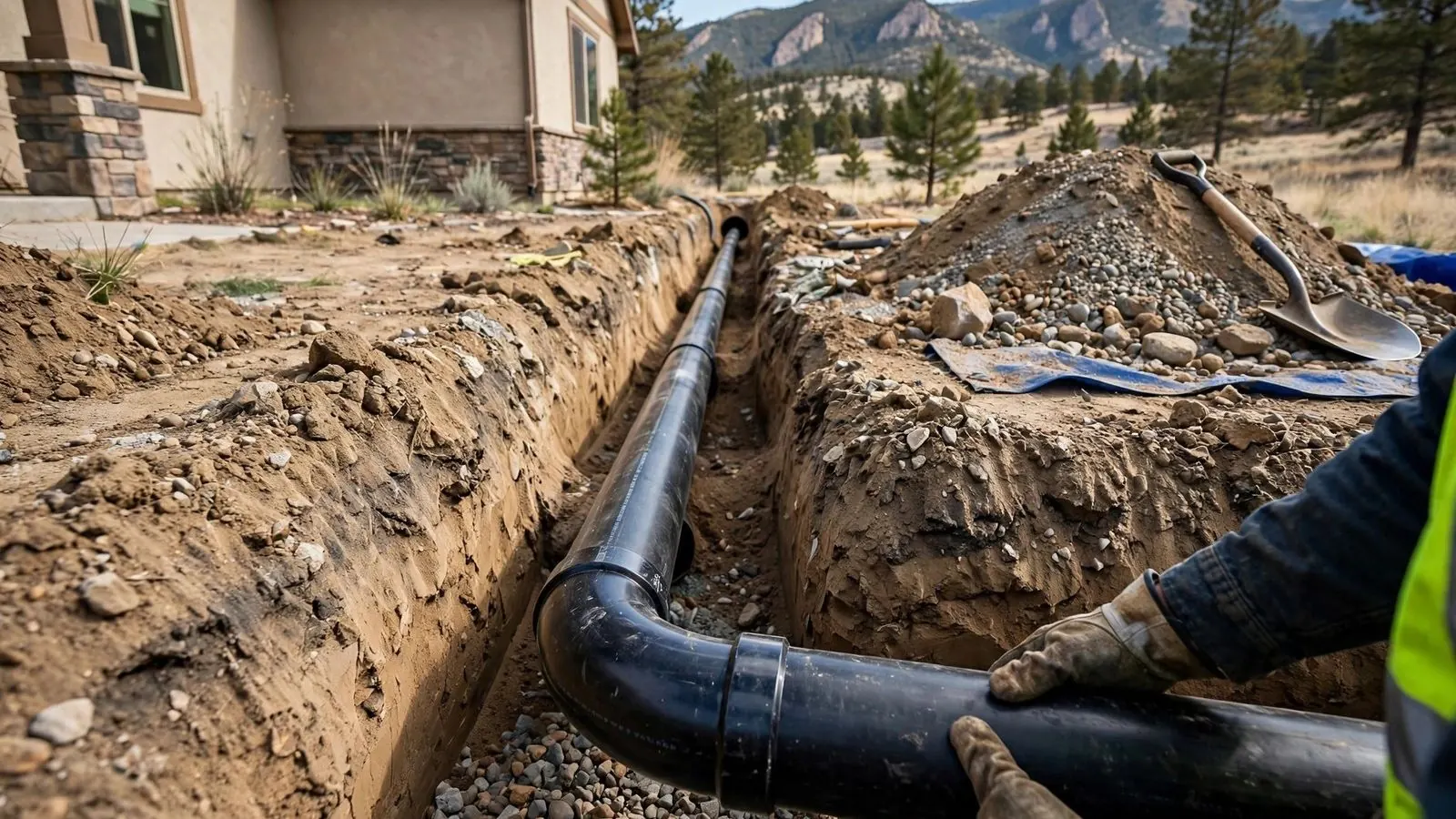
A sewer line that runs under a concrete slab is out of sight, and a break in it can go unnoticed for a long time. When a line breaks under the floor, waste water escapes into the soil, undermining the slab and creating odors and mold. Repair is more involved than a yard line, but it is manageable.
This guide explains the signs, the way we find the problem and the repair options for San Bruno homes.
Signs of a broken line under the slab
- Drains that gurgle or back up even after cleaning.
- Sewage smells indoors, especially near a bathroom.
- Damp or sunken spots in flooring.
- New cracks in tile or the slab.
- Mold or mildew with no obvious water source.
How we find it
A camera is the first tool. We run it down the line from a cleanout or through a toilet flange, recording distance as we go. The camera sees cracks, offsets and sags. A transmitter in the camera head sends a signal that a locator picks up above the floor, so we can mark the break location.
That mark tells us where to open the slab, which keeps the opening small. See sewer camera inspection for more on the camera work.
Repair options
| Option | How it works | Best when |
|---|---|---|
| Spot repair | Break the slab, cut out the bad pipe, replace it and patch the concrete | One short section is damaged |
| Pipe lining | Insert a resin liner that hardens inside the old pipe | The pipe is intact but cracked or leaking at joints |
| Reroute | Abandon the pipe under the slab and run a new line outside or through walls | The slab is hard to open or the damage is extensive |
| Full replacement | Replace the entire line under the slab | The pipe is failing along its length |
What happens during a slab sewer repair
- Confirm the breakWe camera the line and mark the damage location on the floor.
- Protect the homeWe cover floors and seal the work area to control dust and odor.
- Open and repairWe saw-cut and remove the concrete, expose the pipe, replace the damaged section and test it.
- Backfill and patchThe trench is compacted and concrete is patched. Flooring is left for a floor installer.
Why older homes are at risk
Older homes may have cast iron, clay or Orangeburg lines under the slab. Cast iron rusts from the bottom. Clay cracks at joints and lets roots in. Orangeburg softens and deforms. Soil movement and the occasional earthquake add stress.
If your house is older and drains have started acting up, a camera is the best next step. For backups that cannot wait, see sewer line repair.
Cost factors
Under-slab repairs vary with depth, length of damage, floor finishes and access. A spot repair costs less than a reroute, and a reroute may cost less than ripping out a finished floor. We give a number after the camera shows us the problem, and we explain the choices.
Insurance may help with damage but not the pipe itself. Ask your agent first.
Before you dig
Call 811 before any digging, even inside, if the work reaches outside the house. Utilities mark their lines for free. PG&E repeats that advice on its gas safety page, because a nicked gas line is dangerous.
Pipe materials found under slabs
| Material | How it fails | What it means for repair |
|---|---|---|
| Cast iron | Rusts from the inside and bottom, scale narrows the bore | Lining or replacement, depending on wall thickness |
| Clay | Cracks at joints, roots enter | Often replaced, sometimes lined |
| Orangeburg | Softens and deforms into an oval | Usually replaced |
| ABS or PVC | Joint failures or damage during construction | Spot repair is common |
Knowing the material before the work starts changes the plan. A camera shows the pipe and often identifies it by color, joints and texture.
Planning permits, access and your stay
Sewer work usually needs a permit, and the city may inspect the pipe before it is covered. The San Bruno Building Division can be reached at 650-616-7058 for current requirements. Ask your plumber who pulls the permit and who is present for the inspection.
A slab repair creates dust, noise and a trench in the floor. Plan to keep water use low while the line is open. Some households stay elsewhere for a day or two, particularly if the work reaches a kitchen or bathroom. Pets and children should be kept away from the work area.
Flooring is the part people forget. Concrete is patched, but tile, wood and carpet are a separate job. Ask what the quote includes and who will match the flooring. See sewer line repair for the repair options in more detail.
Questions to ask before you sign
- Will the camera recording be given to you?
- Is the quote for spot repair, lining or a reroute, and why?
- Who pulls the permit and meets the inspector?
- How will dust and odor be controlled in the house?
- What does the warranty cover and for how long?
- Who is responsible for flooring and drywall afterward?
A clear answer to each of these is a good sign. Hesitation tells you the plan is not settled yet.
Plumbing problem that cannot wait?
Call the 24/7 line. A dispatcher answers and starts with the first steps.
San Bruno's lateral certificate and digging rules
The City of San Bruno's Point of Sale Sewer Lateral Requirement says that homes over 50 years old need their sewer lateral inspected and certified by the city before sale, and that enforcement began on May 8, 2015. The page lists a compliance certificate, a time extension certificate, an application, and warranty information, and it places the program under Public Works Wastewater.
A slab sewer repair on an older home often turns up in that context, so a camera recording is useful documentation. PG&E's gas safety page repeats the standard advice to call 811 before you dig. The same questions come up for homes in Millbrae and Daly City, where the city offices differ.
Source type: City of San Bruno Point of Sale Sewer Lateral Requirement page and PG&E gas safety page. Facts are stated according to each agency's own published page.
Questions about this topic
We run a camera through the line from a cleanout and mark the location of the damage with a locator above the floor. Cleaning first is often necessary to see the pipe.
Often yes, but not always. Trenchless lining can repair a cracked pipe from the inside if it is still round and continuous. Where pipe has collapsed or offset, a section has to be exposed and replaced.
Gurgling drains, sewage smells, wet or sunken spots in the floor, cracks, mold and repeated backups after cleaning. The camera is the way to confirm.
Coverage varies. Some policies cover resulting damage but not the pipe, and some offer an endorsement. Ask your agent before work starts.