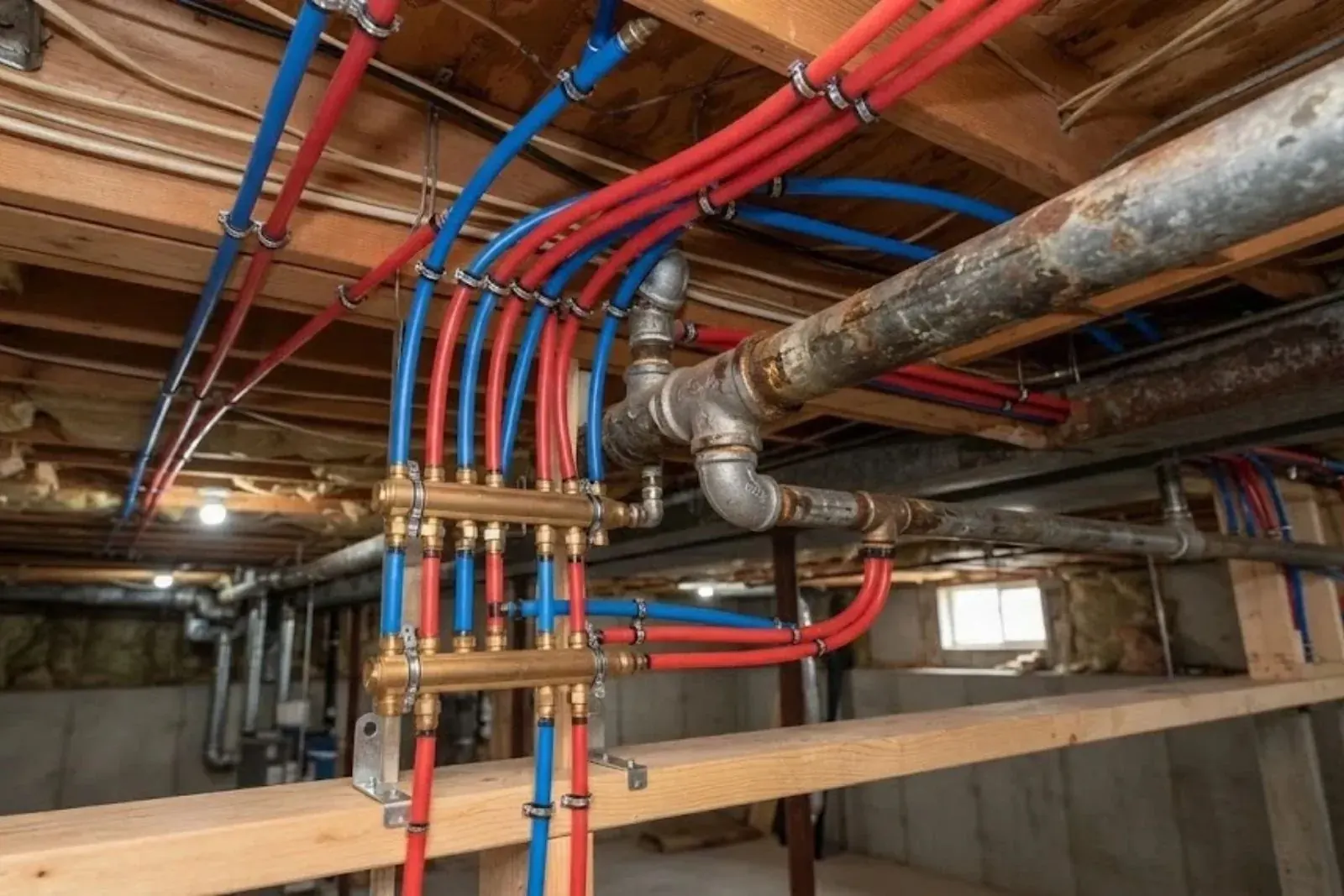
Repiping replaces the supply lines inside your walls, floors and crawlspace. It is a planned project, not an emergency, but the pipes it replaces often fail in an emergency first. When pinhole leaks keep returning, repeated repairs cost more than a single replacement.
This page explains the signs, the materials, the process and the local conditions that matter in San Bruno.
Signs your house may need a repipe
- Pinhole leaks that keep appearing in different spots.
- Brown, yellow or rusty water from taps, especially after the water sits overnight.
- Low water pressure that worsens even though the city supply is steady.
- Corroded, flaking or green-stained pipes and fittings.
- A house with original galvanized steel supply lines.
Galvanized pipe replacement
Galvanized steel was a common supply line in older homes. It rusts from the inside, narrowing the pipe until pressure drops and water turns brown. Eventually, a fitting or a thin spot gives way.
Once galvanized lines start to fail, the next section is usually close behind. We replace the whole run, since patching one leak does little for the rest.
PEX or copper for your repipe
| Feature | PEX | Copper |
|---|---|---|
| Installation | Flexible tubing, fewer wall openings | Rigid pipe, more joints and cuts |
| Speed | Often faster | Slower, soldered or press joints |
| Freezing | Tolerates expansion better | Can split if frozen |
| Sun exposure | Must be protected from UV | No UV concern |
| Corrosion | Does not corrode | Can corrode with water chemistry |
| Feel and familiarity | Newer, widely used | Long track record |
Considering a repipe?
Call to talk through the signs and options. Planned work is scheduled in regular hours.
What the city's water report says about copper and lead
These numbers come from the City of San Bruno 2023 water quality report. They describe a sample of homes, not yours. Copper in tap water usually comes from household plumbing, so older copper lines and acidic or aggressive water can contribute.
If you are worried about your own water, ask us about testing, or contact the San Bruno Water Division at (650) 616-7162.
The repipe process
- Inspect and planWe trace your existing lines, locate shutoffs and plan the new route and manifold or branch layout.
- Protect and openWe protect floors and furniture and cut access holes in drywall at planned points.
- Run new pipeNew lines go in, connected to each fixture, with pressure testing before walls are closed.
- Inspect and patchPermit inspection happens, then we patch the openings. Painting and texture are left to you or a contractor.
Housing in San Bruno and why age matters
San Bruno has about 16,622 housing units, and 55.5 percent are owner-occupied according to the 2020 census figures cited on Wikipedia. The city grew after the 1906 earthquake and spread across the decades that followed, so plumbing eras are mixed.
Homes with original galvanized lines are candidates. Homes with 1970s or 1980s copper may be fine. We look at your pipes before recommending anything.
Pressure, hills and your new pipes
A repipe is a good moment to check water pressure and add a regulator if needed. San Bruno's system uses 31 pressure regulating stations to serve elevations from the flats to the foothills, so pressure varies by street.
We measure at a hose bib with a gauge, and if it runs high, a pressure regulator protects the new pipes and your fixtures.
What affects repiping cost
Repiping prices vary by house, and the number comes after an inspection.
- House size and floorsMore fixtures and more floors mean more pipe and labor.
- MaterialPEX and copper cost differently.
- AccessA crawlspace helps. Slab foundations or finished ceilings add work.
- Drywall repairWe patch openings. Paint and texture are separate.
- Permit and inspectionFees and timing are part of the plan.
Insurance generally does not pay for replacing old pipe that has not burst, though sudden damage from a failure may be covered. Want your real number? Call (650) 860-1670.
If a pipe has already failed, see burst pipe repair for the emergency side. If the leak is under a slab, slab leak repair covers rerouting, which is often a partial repipe. We repipe homes in Daly City and nearby towns too.
Permits and inspection for a repipe
A repipe is permitted work under the California Plumbing Code, which San Bruno adopts under section 11.20.010. The inspector checks the pipe, the fittings and the pressure test before the walls are closed.
The Building Division accepts permit applications through its SB Permits portal, and its counter is open Monday to Thursday.
Frequently asked questions
Common signs are repeated pinhole leaks, brown or rusty water when you first open a tap, low pressure that gets worse over time, and visible corrosion on pipes in the basement, garage or crawlspace. One leak does not mean a repipe, but a pattern of leaks does.
Most homes take a few days. The work involves opening walls at strategic points, running new lines, connecting fixtures and patching drywall. Water is off for part of each day. Larger or two-story homes take longer.
Both work. PEX is flexible, faster to install and resistant to freezing damage, so it often needs fewer wall openings. Copper is rigid, durable and familiar. We explain which suits your house, your water and your budget.
Repiping a house is a major plumbing change, and permit rules vary, so ask the San Bruno Building Division. Its online system is SB Permits and its phone is 650-616-7058. We handle the permit and inspection steps for work we do.
New pipe removes corroded sections that may flake or leach. San Bruno's 2023 water quality report says 1 of 39 sampled homes exceeded the copper action level in 2022 testing and none exceeded the lead action level. That is a city sample, not a test of your house. To know your own water, ask about testing.